News
Thomas Jefferson High School Students Advance to International Math Finals After Tackling the Real-World Impact of Sports Gambling

When people think of competitions involving high school students, they often imagine athletics, debate tournaments, robotics events, or science fairs. Rarely do they picture a group of teenagers spending fourteen straight hours behind screens and notebooks, locked into complex conversations about mathematics, economics, behavioral trends, and societal impact. Yet for five students from the DMV, that exact kind of marathon problem-solving session has now placed them among the top young mathematical minds in an international competition.
Students from Thomas Jefferson High School for Science and Technology in Alexandria have officially advanced to the finals of the prestigious MathWorks Math Modeling Challenge (M3 Challenge), earning a place among just nine finalist teams selected from hundreds of competitors across the United States and the United Kingdom. More importantly, the accomplishment places the team in contention for a share of $100,000 in scholarship awards, with the top team set to receive $20,000.
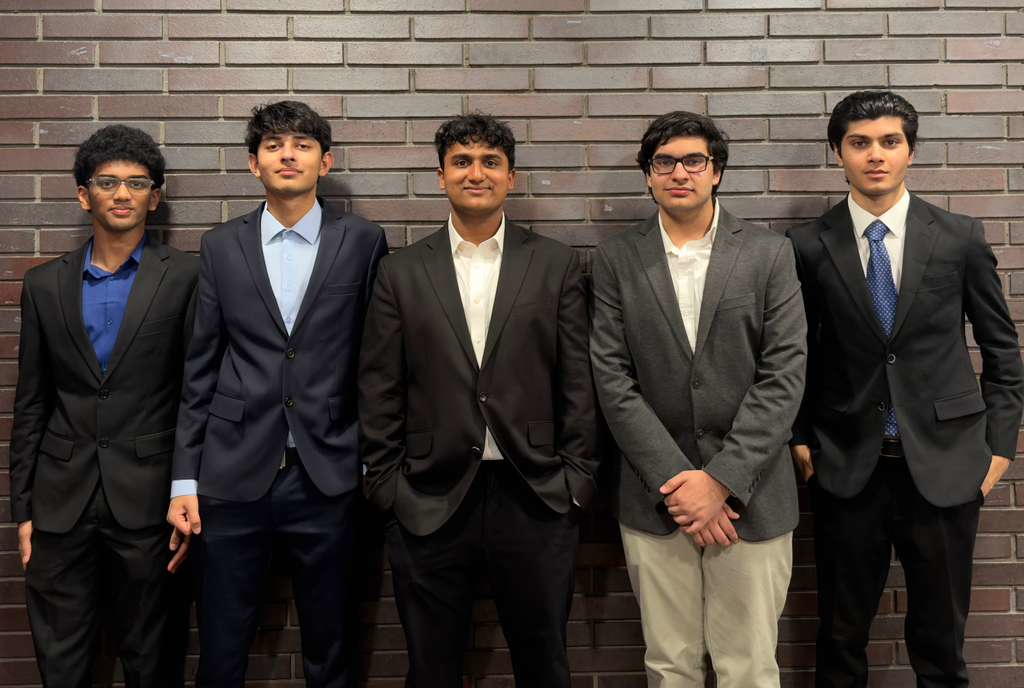
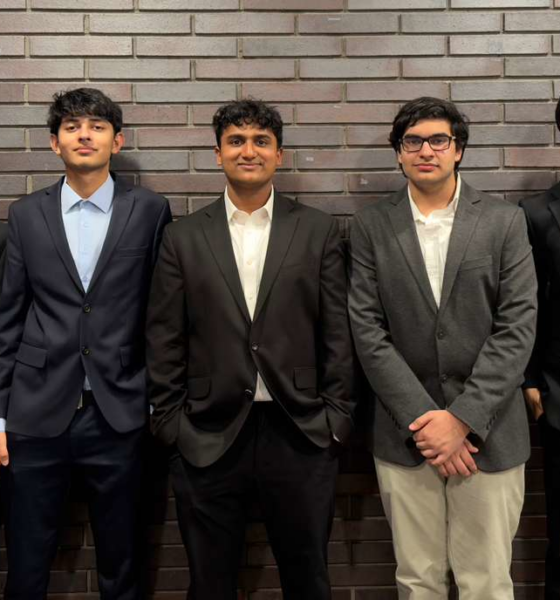
Representing the DMV on the international stage are Ashwath Muppa, Shresth Jaiswal, Varun Ananthakrishnan, Agastya Sondhi, and Adhiraj Chhoda. Together, the students took on one of the most culturally relevant and increasingly complicated issues affecting younger generations today: the rise of online sports gambling and its financial and social implications.
Their journey began in early March, when the team joined thousands of students participating in the annual M3 Challenge. Unlike traditional mathematics competitions centered around equations and standardized problem sets, M3 places students in situations designed to mirror real-world decision making. Teams are asked to use mathematical modeling to address large-scale societal questions and produce solutions that can realistically inform public understanding and policy.
This year’s challenge pushed students into a topic dominating modern sports culture and online conversation. Sports betting apps and gambling platforms have become deeply integrated into everyday sports experiences. Pregame discussions now regularly involve betting odds, parlays, over-under predictions, and wagering strategies. For many younger audiences, sports gambling has become inseparable from sports itself.
That reality inspired the central question behind this year’s competition: should society be concerned about the rapid growth of online sports gambling?
But answering that question required much more than opinions.
Teams needed to quantify broader impacts through mathematical analysis. Students were tasked with estimating how much money people in the United States and United Kingdom lose annually through sports betting, determining thresholds for harmful gambling behavior, and analyzing how disposable income and demographic factors influence financial risk.
For the Thomas Jefferson students, that challenge required a blend of technical skill, collaboration, and critical thinking under pressure.
For fourteen straight hours, the team worked through assumptions, debated methodology, developed models, and attempted to turn abstract societal concerns into measurable outcomes. Their work then faced multiple rounds of judging and extensive review before emerging as one of the strongest submissions in the competition.
Now, the final step awaits.
On April 27, the team will travel to New York City, where they will present their findings before a panel of professional mathematicians in the final round of competition. Their presentation will serve as the last stage of evaluation before scholarship placements are announced.
While the numbers surrounding the competition are impressive, the scale of their accomplishment becomes even more significant when viewed in context.
This year’s M3 Challenge attracted more than 3,430 eleventh and twelfth grade students across 770 teams. More than seventy percent of participating teams represented schools throughout the United States, spanning forty states, while additional teams competed from schools across the United Kingdom.
Advancing to the final nine places the Thomas Jefferson students among an exceptionally small group.
Yet beyond rankings and scholarships, what stands out most is the nature of the work itself.
According to Dr. Neil R. Nicholson, a professor at the University of Notre Dame and member of the M3 Problem Development Committee, the topic emerged from observing broader shifts in sports culture itself.
“More and more, conversations around sports are filled with spreads, lines, and suggested parleys,” Nicholson explained.
Rather than approaching gambling from a purely moral perspective, organizers wanted students to examine the role sports betting currently occupies in society and explore its relationship to affordability, spending behavior, and broader economic realities.
Students were also challenged to think beyond calculations themselves.
The competition intentionally emphasized communication and public understanding alongside technical accuracy. Participants needed to explain their findings in ways everyday audiences could understand, reinforcing the idea that mathematics extends far beyond equations and classrooms.
Data only matters if people can understand what it means.
That emphasis on communication mirrors real-world problem solving in important ways. Analysts, researchers, and policy experts frequently face challenges that require not just technical skill, but the ability to translate complicated findings into information communities can actually use.
For the Thomas Jefferson team, that process became central to their success.
According to mathematics teacher and team coach Manisha Chhoda, the students approached the competition with an impressive level of independence.
“The students were self-directed from start to finish,” she explained. “They divided the modeling work, pressure-tested each other’s assumptions, and produced a paper in a single weekend.”
That process reflected more than academic ability. It demonstrated teamwork under pressure and a willingness to challenge ideas collaboratively.
Chhoda emphasized that experiences like the M3 Challenge help students develop analytical and problem-solving skills that extend well beyond competition environments.
Those lessons may ultimately become more valuable than trophies themselves.
Team member Adhiraj Chhoda also highlighted the group’s approach, explaining that the students spent significant time discussing strategy before diving into coding or calculations.
“We spent a lot of time before writing any code on discussing what the model needed to do,” he said.
Instead of treating each question separately, the team built interconnected systems that linked disposable income, gambling behavior, and household outcomes together. That layered structure allowed students to identify flaws and assumptions they might otherwise have missed.
The process reflected something increasingly important in modern education: understanding that real-world problems rarely fit into isolated categories.
Social issues overlap.
Economics overlaps with psychology.
Technology overlaps with culture.
And increasingly, mathematics exists at the center of all of it.
For the DMV specifically, the team’s success continues a long-standing reputation for academic excellence and innovation. Thomas Jefferson High School for Science and Technology has become nationally recognized for producing high-achieving students across STEM disciplines, but accomplishments like this represent more than school rankings or prestige.
They highlight what becomes possible when young people are given opportunities to apply knowledge beyond textbooks.
In this case, five students from Alexandria did not simply solve equations.
They tackled a growing societal issue, built analytical frameworks around it, and earned recognition on an international stage while doing so.
Now, with the final round approaching in New York, the DMV will be watching as they take the next step.
And regardless of the outcome, they have already proven something important:
Some of the region’s brightest minds are not waiting until adulthood to help solve real-world problems. They’re already doing it.




Marcus “Polo” Pilgrim Is Building a Bigger Table for Prince George’s County

Library of Congress Monthly Family Days Continue Through December 2026

Former Forest Park Teacher, Coach Acquitted of Indecent Exposure Charges

Iron Maiden and Megadeth played to a sold-out crowd at Jiffy Lube Live in Bristow

HBCU Week NOW Officially Launched Nationwide In Search For The Next Generation of HBCU Storytellers

Mike D Brings Beastie Boys Classics and a New Chapter to a Sold-Out 9:30 Club

World’s Largest Black Music Fest “AFRO+” Hits DMV, Expecting Over 120K Festival Goers.

Chichi Goon Puts His Dreams on Display With “I Have A Dream”

Psalm + Petal Co.: Turning Grief, Faith and Beauty Into Meaningful Floral Experiences

Devin McCoy: Building a Media Movement in the DMV With The Floaters

Monumental Sports Network and DAZN partnered to stream Capitals, Wizards, and Mystics games via Monumental+ on the DAZN platform.

Ten Entrepreneurs From The DMV To Look Out For

Lanterns Season 1 Preview: When Green Lantern Meets True Detective

Keeping Hopes Alive Is Redefining Mental Health and Healing in Baltimore

Keys to Wealth Fest Brings Financial Literacy, Entrepreneurship and Community Together in DC

Josh Christina and Charlie Berry III Gear UP To Release A New Song Together “Rock Revival”

April + VISTA Bring Traditional Noise to DC for Songbyrd Performance

Founding Farmers Restaurant Group Brings Texas-Inspired Barbecue to the DMV with Chef Joe’s New Summer Menu

After Surviving Paralysis, Shamila Beslow Is Premiering Her Most Personal Film Yet

How Paradise and Silo Are Very Similar But Different Shows
Founding Farmers Restaurant Group Brings Texas-Inspired Barbecue to the DMV with Chef Joe’s New Summer Menu
After Surviving Paralysis, Shamila Beslow Is Premiering Her Most Personal Film Yet
April + VISTA Bring Traditional Noise to DC for Songbyrd Performance
Keys to Wealth Fest Brings Financial Literacy, Entrepreneurship and Community Together in DC
Josh Christina and Charlie Berry III Gear UP To Release A New Song Together “Rock Revival”
Lanterns Season 1 Preview: When Green Lantern Meets True Detective
Keeping Hopes Alive Is Redefining Mental Health and Healing in Baltimore
Ten Entrepreneurs From The DMV To Look Out For
Iron Maiden and Megadeth played to a sold-out crowd at Jiffy Lube Live in Bristow
Psalm + Petal Co.: Turning Grief, Faith and Beauty Into Meaningful Floral Experiences
Devin McCoy: Building a Media Movement in the DMV With The Floaters
Monumental Sports Network and DAZN partnered to stream Capitals, Wizards, and Mystics games via Monumental+ on the DAZN platform.
Mike D Brings Beastie Boys Classics and a New Chapter to a Sold-Out 9:30 Club
HBCU Week NOW Officially Launched Nationwide In Search For The Next Generation of HBCU Storytellers
Chichi Goon Puts His Dreams on Display With “I Have A Dream”
World’s Largest Black Music Fest “AFRO+” Hits DMV, Expecting Over 120K Festival Goers.
Former Forest Park Teacher, Coach Acquitted of Indecent Exposure Charges
Library of Congress Monthly Family Days Continue Through December 2026
Marcus “Polo” Pilgrim Is Building a Bigger Table for Prince George’s County
-

 Breaking11 months ago
Brinks Driver Attacked, $500K Stolen Outside Navy Federal Credit Union in Clinton
-

 Community10 months ago
The Maine Announces 2026 Headline Tour With April 19th Stop at DC’s 9:30 Club
-

 Community11 months ago
Netflix To Transform D.C.’s Historic Woodies Building Into A Creative Hub.
-
 Maryland News10 months ago
State of Maryland Faces A $1.4 Billion Deficit Heading Into 2026